ENG

 English
 Français
 Español
 عربى

A 30 cm rollout on a smooth wooden floor is where most abdominal wheel problems appear: the wheel slides away faster than the user can brace, the lower back arches, and the set ends at the first twinge. The wheel itself rarely fails — but the wrong wheel, matched to the wrong user, produces exactly that scene in living rooms, hotel gyms and small studios. Here is the short version first: the abdominal wheel is an anti-extension core tool whose difficulty is set mainly by how far you roll, and the model you choose should match the user's bracing strength, the floor surface and the noise limits of the space.
What an Abdominal Wheel Really Trains
An abdominal wheel is not a crunch machine; it is a moving plank. As you roll out, the lever arm between shoulders and hips lengthens, so the same bodyweight becomes harder to hold in a neutral position. The main job is anti-extension work: the rectus abdominis, obliques and transversus abdominis resist the lower back arching, while the lats and serratus anterior take a bigger share at the far end of the range.
That is also why the wheel exposes hip-flexor dominance so quickly. Anyone who feels the movement in the front of the hips instead of the stomach is usually letting the pelvis drop, or pulling with the psoas rather than holding a posterior tilt.
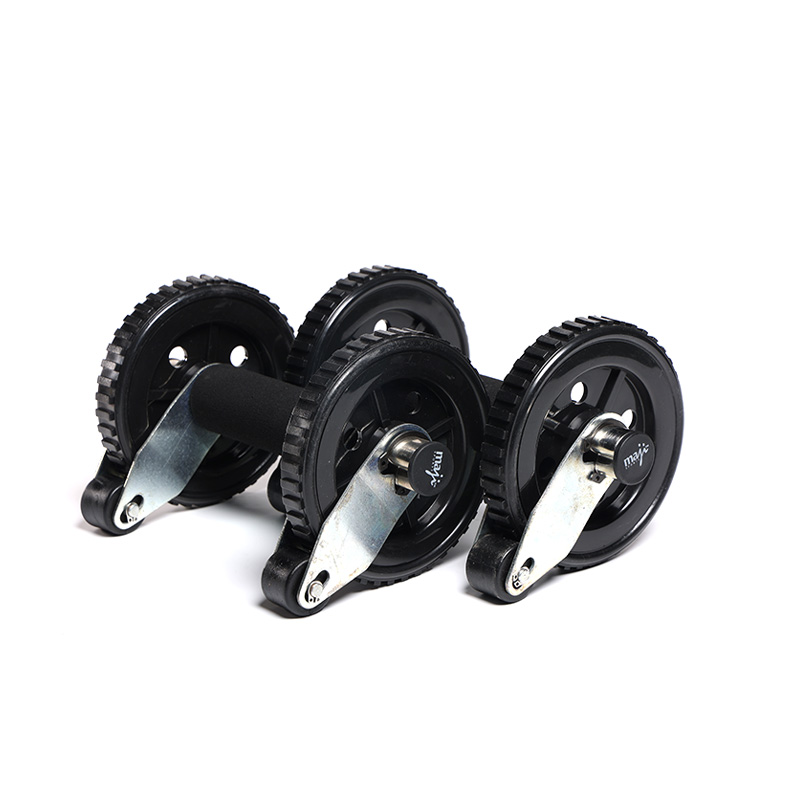
Isometric view: two wheels, a through-axle, sleeve grips and a treaded rim — the four parts that decide stability.
Structurally, most abdominal wheels are simple: one or two wheels, a steel or alloy axle, grip sleeves over the axle ends, and a hub that locates the bearings. That simplicity is exactly why quality differences surface so fast — a hollow axle, an undersized hub, or a rim that is too hard and slick will wobble and skid under a 70–80 kg user on tile.
Rollout Technique That Protects the Lower Back
Coaches at Tucson Strength apply a sensible gate to the exercise: if someone cannot hold a solid plank for 15–20 seconds, a rolling version is premature. Use that as a screening test rather than something to train past.
If you print instructions for retail packaging, these five points cover most of what goes wrong:
- Kneel on a mat with the wheel under the shoulders, arms straight and wrists neutral.
- Tuck the pelvis and drop the ribs slightly, so the low back stays flat rather than arched.
- Roll forward only as far as a neutral spine holds — distance is the intensity dial, not speed.
- Exhale on the way out and inhale on the return; end the set when the pelvis starts to sag.
- Begin with wall stops or partial range, then add 5–10 cm of range per week instead of extra reps.
Bars show approximate ranges compiled from published core EMG literature; absolute values vary by study, load and technique. Read it as a ranking, not a measurement.
The practical takeaway is simple: the wheel belongs above the crunch and plank on a progression ladder, and the standing version sits above the kneeling one. Users who cannot yet keep a flat back should stay with partial rollouts.
When the Problem Is the Wheel, Not the User
Three failure patterns come back from retail customers most often, and each maps onto a design decision rather than a training error.
- Runaway rollouts. A free-spinning wheel on laminate accelerates away from beginners. A brake-style hub or a slightly wider, grippier tread gives the control that lets a first-time user finish a set.
- Wobble at full extension. Single-wheel models demand balance and track unpredictably on carpet edges. Dual wheels hold a straighter line, which matters more for home users than for experienced lifters.
- Noise and floor marking. Hard PP rims click and skate on wood. TPR or foam-jacketed rims with a wider contact patch run quieter, which is the difference between a product that gets used and one that stays in the box.
The five-, six- and eight-hole patterns on the side plates are largely styling and hand-position variants. They change how the wheel looks and where the hands sit, not the physics of the rollout — useful to know before you pay a premium for a pattern alone.
 OEM Brake Abdominal Wheel for Strength TrainingBrake Abdominal Wheel with PP/PVC/TPR build and 680 g weight; worth checking as a compact strength-training option before comparing side-plate patterns.View Product →
Specification Points Buyers Should Confirm Before Ordering
A sample that feels fine for ten rollouts can still generate returns in the field. The seven points below are the ones that most often separate a repeat order from a complaint file.
| Specification | What to check | Why it matters |
|---|---|---|
| Wheel diameter and tread width | Measured diameter, tread width and rim hardness | Narrow hard wheels skid; a wider tread tracks straighter on tile and low-pile carpet |
| Wheel count and axle | Single or dual wheel, axle material and diameter, how the hub is fixed | Hollow or undersized axles develop play and rattle within weeks |
| Rim material | PP, PVC, TPR or foam-jacketed construction | PP is stiff and inexpensive but noisy; TPR grips better and runs quieter indoors |
| Grip sleeves | Foam, EVA or TPR sleeve, sleeve length, end caps, bonding method | Sleeves that rotate or slide off are the single most common after-sales complaint |
| Brake or resistance module | Whether the hub carries a brake, spring return or nothing at all | Brake versions suit beginners; confirm the mechanism survives drop and cycle testing |
| Packaging and documents | Carton strength, assembly sheet, warning labels, barcode and language versions | Retail-ready packaging cuts importer handling; missing warnings create liability |
| Test reports | Static load target, drop test and cycle test documentation | Ask for reports rather than verbal assurances, and check the model matches the report |
For a mixed retail range, a wider wheel is usually the safest second SKU: it suits heavier users, uneven floors and group settings, and it photographs well next to a standard model.
 Wide Wheel Abdominal Wheel for Core TrainingWide 18.5 cm abdominal wheel with PP/PE/TPR build and 650 g weight, offering a larger contact area for stable core, back, arm and leg training.View Product →
A Practical Eight-Week Progression
Programmes sell wheels, so it is worth shipping one with the product. The structure below works for most healthy adults and needs no extra equipment beyond a resistance band for the final stage.
- Weeks 1–2: partial rollouts to a wall stop, 3 sets of 6, slow and controlled.
- Weeks 3–4: full kneeling rollouts at a 3-second-out, 3-second-back tempo, 3 sets of 8.
- Weeks 5–6: kneeling rollouts with a 2-second pause at full extension, 3 sets of 6.
- Weeks 7–8: band-assisted standing rollouts or standing negatives, 3 sets of 5.
Apartment users should prioritise a quiet rim and a stable dual-wheel base over extra features. A silent build with foam grips is the configuration that survives daily home use without annoying the neighbours below.
 Silent PP+PVC+Foam Abdominal Wheel for Home UseSilent PP/PVC/foam abdominal wheel with 680 g weight and compact 22×15.5 cm design; suited to quiet home training where portability and grip matter.View Product →
Sourcing Notes for Importers and Brand Owners
Abdominal wheels are a low-cost, high-volume item, which means material and tooling choices — not assembly labour — decide the price band. Two questions do most of the work in a supplier conversation: which rim compound is used, and how the axle and hub are fixed. From there, carton configuration, sleeve material and whether the side plates are shared across models determine both landed cost and the number of SKUs you can realistically list.
StarryFit Sport lists more than ten abdominal wheel variants, including brake, five-hole, six-hole, eight-hole, flat, U-shaped, wide, silent and multifunction builds, and states that its new-generation abdominal wheel has obtained a national patent. Buyers evaluating that claim should request the patent number alongside the certificate scans, in the same way they would verify any factory audit. Our factory overview and certificates and honours pages are the usual starting points for that check.
One practical tip from the sampling stage: test the wheel on the surface your end customer will actually use. A model that rolls cleanly on a rubber gym floor can behave very differently on polished tile, and that single test predicts return rates better than any spec sheet.
Frequently Asked Questions
What muscles does an abdominal wheel work?
Mainly the rectus abdominis, obliques and transversus abdominis, with the lats and serratus anterior assisting at full extension. It is an anti-extension exercise rather than a crunch variation.
Can beginners use an ab roller?
Yes, if they can hold a plank for 15–20 seconds and start with partial range or a wall stop. A brake-style wheel makes the first weeks considerably safer.
How do you use an abdominal wheel without back pain?
Keep the pelvis tucked, the ribs down and the low back flat, and roll only as far as that position holds. Pain usually means the range is too long, not that the wheel is wrong.
How many ab wheel rollouts should I do a day?
Three to four sets of 6–12 reps, two or three times a week, is plenty for most people. Daily maximum-effort sets tend to break form before they build strength.
Is a single wheel or double wheel ab roller better?
Dual wheels track straighter and suit home users and heavier athletes; single wheels demand more balance control. For retail ranges, dual-wheel models return fewer complaints.
Do ab wheels work on carpet?
They work on low-pile carpet but drag on thick pile, and a narrow hard rim can catch on seams. A wider tread and a smoother rim compound handle soft flooring far better.