ENG

 English
 Français
 Español
 عربى

Grip trainers arrive under a dozen names — hand grip strengthener, hand exerciser, finger trainer, grip ring, forearm builder — and buyers who assume those names describe the same object end up comparing quotes for products that are not interchangeable. A 20 kg silicone ring and a 20 kg plastic adjustable gripper feel nothing alike in the hand, and neither behaves like a 150 kg torsion gripper.
Short answer: five families are worth separating on a spec sheet. Spring-loaded grippers (fixed, adjustable and heavy torsion models), silicone or TPR grip rings, squeeze balls and massage grip rings, finger stretchers and hand resistance bands, and hybrid designs such as counting grippers. Each one loads a different part of the grip, at a different resistance, with its own failure mode.
Category matters beyond catalogue tidiness. Grip strength tracks whole-body health closely enough that clinicians use it as a screening marker — in the PURE study published in The Lancet in 2015, every 5 kg decrease in grip strength was associated with roughly a 16% higher risk of all-cause mortality. Trainers are now specified for rehab clinics and older-adult fitness programmes, not only for powerlifters, so the load range has to match the user.
The five families at a glance
The two columns that decide a reorder are the rating method and the wear part. Everything else is packaging.
| Type | How resistance is created | Typical rated range | Best for | Buyer watch-out |
|---|---|---|---|---|
| Fixed spring gripper | Steel compression or torsion spring between two handles | 10–40 kg | Entry-level crushing strength | Spring set, foam handle peel |
| Adjustable gripper | Knob or screw changes spring preload | 10–60 kg | Progressive training | Detents slipping under load |
| Heavy torsion gripper | Rated steel spring, knurled aluminium handles | 50–150 kg | Specialist maximal strength | Rating method not disclosed |
| Silicone / TPR ring | Elastomer wall compressed by the fingers | 5–50 kg | Endurance, rehab, kit inserts | Durometer drift between batches |
| Finger stretcher / band | Elastic loops or band resisting extension | 2–15 kg | Extensor balance, forearm rehab | Tear at the finger web |
1. Spring-loaded grippers: fixed, adjustable and heavy torsion
Two handles, one steel spring. Resistance is set by wire diameter, coil count and material grade — 65Mn carbon spring steel is the common choice, with stainless appearing in salt-air markets.
Three builds sit under this heading. Light grippers with foam or TPR handles generally rate 10–40 kg and are the volume retail product. Adjustable grippers add a knob that changes spring preload, covering roughly 10–60 kg in one unit; the detents must hold, or resistance drifts mid-set and the user thinks their hand got weaker. Heavy torsion grippers use knurled aluminium handles and rated springs from about 50 kg to 150 kg in numbered steps — a specialist item with a specialist buyer.
Ask how the rating is defined. Kilograms at first contact and kilograms at full close are very different numbers on the same tool. Ask for a cycle test as well; 10,000 to 20,000 compressions is a reasonable buyer specification before permanent set appears.
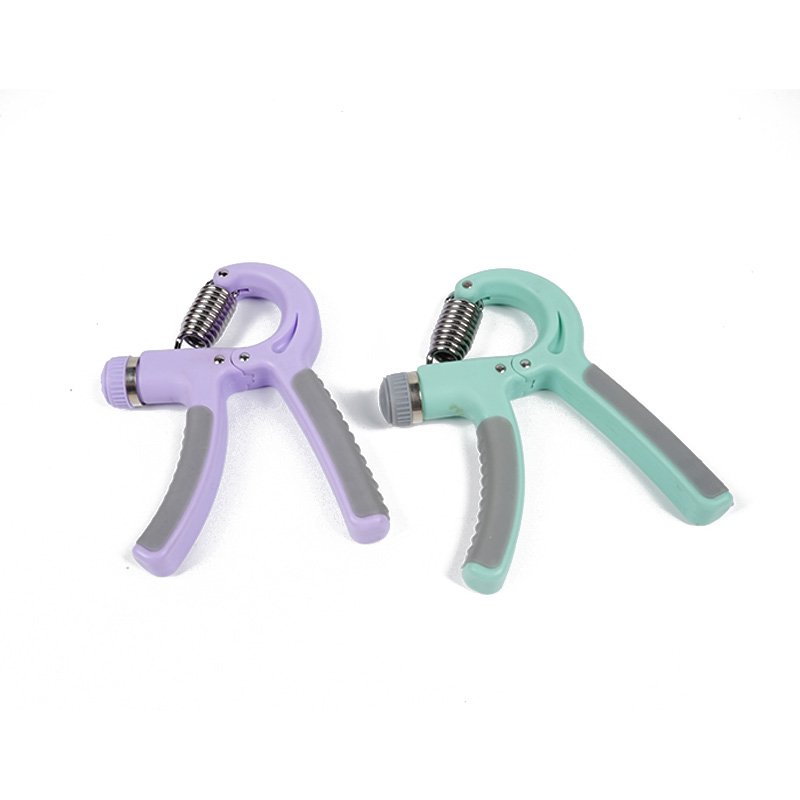 Adjustable Hand Grip for Strength TrainingReview this PP+PVC adjustable hand grip, with 14.3 cm handle and 275 cm rope, before confirming resistance ratings and cycle-test specifications.View Product →
2. Silicone and TPR grip rings
An elastomer ring compressed between fingertips and palm. No moving parts, no spring to fatigue, and a unit cost low enough that rings work as kit inserts and promotional items. Catalogue ratings usually span 5–50 kg, driven by wall thickness and durometer — most production falls between 30 and 70 Shore A.
The catch is tolerance. A five-point Shore A drift between batches is a different product in the user's hand, and printed resistance numbers only mean something if the factory tests each cavity. Rings are also the most therapy-friendly format: they can be squeezed for flexion or opened against the fingers for extension, they wash clean, and silicone versions avoid latex concerns. Typical complaints are splitting at the inner wall on thin sections and printed markings polishing off after repeated washing.
 Silicone Grip Ring for Hand StrengtheningSilicone hand-grip ring measuring 8 cm diameter and 83 g, presented by an OEM supplier; check batch tolerance and wall durability.View Product →
3. Squeeze balls, therapy putty and massage grip rings
"Hand exercise ball" covers several unrelated products. Soft foam or TPR squeeze balls are a genuine strength tool at the very light end — effectively unrated, useful for warm-ups, post-surgical protocols and older users who cannot close a spring gripper. Spiky or floating-point massage balls are recovery items, rolled under the palm and along the forearm rather than squeezed. Silicone massage grip rings sit between the two, sold as stress relief with light resistance.
None of these are progressive load tools. They cannot be rated reliably, so a line that reads "20 kg ball" deserves a question. Their value is comfort, texture and price point.
4. Finger stretchers and hand resistance bands
This group loads the opposite direction. A finger stretcher is five elastic loops on a hub; the user pushes the fingers apart against the band, training the extensors that no gripper touches. Total resistance is light — roughly 2–8 kg across the whole hand — and that is deliberate.
Hand resistance bands do similar work with a flat or tubular band held across the fingers. They appear in climbing programmes, racquet-sport conditioning and physiotherapy protocols where flexion work is paired with extension work in a set ratio. Quality issues are predictable: latex versus silicone declarations, loop tear at the web where stress concentrates, and sizing, since a stretcher built for a large hand slides off a smaller one.
 Finger Stretcher for Hand Grip StrengtheningOEM finger stretcher listed in the hand-grip strengthener range; product details are limited, so confirm materials and sizing before sourcing.View Product →
5. Counting grippers and hybrid designs
A mechanical counter turns a gripper into a tracking device, which is why the format sells to rehab patients, coaches and anyone following a programmed rep scheme. The counter is also the weakest component: a digit wheel driven by a small lever can under-count short partial reps and over-count bounce. Verify counter accuracy over 1,000 cycles and check that the reset button cannot be triggered inside a gym bag.
Other hybrids are cosmetic rather than functional — transparent shells that show the spring, two-colour foam handles, oversized grips for users with limited hand closure. They sell, but they do not change the training stimulus.
Typical rated resistance by type
The chart places common catalogue ratings side by side. Read them as category ranges rather than a promise about any single SKU — a light torsion gripper and a heavy adjustable gripper can overlap in the middle.
Figure 1: typical rating ranges published across the category. Rating points differ between manufacturers.
Inside an adjustable gripper
Most returns trace back to two components, not the shell. The exploded view shows where a specification actually lands.
The pad wears first and shows it: cracked edges, a printed rating that has rubbed away. The spring decides whether the tool still measures what it claims after three months of daily use.
Specifying grip trainers without reorders
- Rating definition. Confirm whether the figure is measured at open, mid-travel or full close, and request a force curve for anything above 40 kg.
- Spring data. Wire diameter, material grade and a cycle test report matter more than the marketing name printed on the spring.
- Elastomer data. Shore A durometer with a stated tolerance, tear strength, and a latex-free declaration for clinical channels.
- Handle durability. Foam density and adhesion for foam grips; salt-spray hours for exposed steel parts.
- Markings. Pad-printed resistances should survive a rub test and repeated washing, or the ring becomes anonymous within a month.
- Counter accuracy, if fitted. Verify over at least 1,000 cycles and confirm the reset cannot be triggered accidentally.
None of this is exotic, but it only appears in a quotation when it is asked for. Buyers who want to see the production side before committing can review our factory and workshop profile, and the purchasing FAQ covers sampling, tooling and order handling in more detail.
Frequently asked questions
What are the different types of hand grip strengtheners?
Five main types: spring-loaded grippers (fixed, adjustable, heavy torsion), silicone or TPR grip rings, squeeze and massage balls, finger stretchers and hand bands, and counting or hybrid grippers. Each loads the hand differently and covers a different resistance range.
Which resistance level should I choose?
Start below your maximum close. Most adults new to grip training manage 10–25 kg; trained users often work between 30 and 60 kg on an adjustable gripper. Heavy torsion grippers above 60 kg are specialist tools, so buyers ordering for a mixed clinic or gym should stock at least three levels.
What is a good grip strength score?
On a hand dynamometer, adult men typically test around 40–50 kg and women around 25–30 kg, with results declining after about age 50. Read any figure against age, sex and body size, and against your own baseline rather than a chart.
Are silicone grip rings as effective as spring grippers?
They train the same muscles but cannot reach the same loads, and the resistance curve differs — a ring gets harder the further it compresses. Rings suit endurance, rehab and warm-ups; spring grippers suit maximal strength work above roughly 30 kg.
Can grip training help tennis elbow?
It is used in rehabilitation, but load management decides the outcome. Light extension work with a finger stretcher or soft ring, progressed slowly, is the usual starting point; heavy crushing work during a flare-up tends to make symptoms worse.
How long should a grip strengthener last?
A silicone ring has no wearing mechanism and usually outlasts the packaging. A spring gripper should hold its rating for several thousand compressions; if the handles close noticeably further than they did when new, the spring has taken a permanent set.