ENG

 English
 Français
 Español
 عربى

A 65 cm yoga ball can leave the same factory at 1.1 kg or 1.8 kg, packed in identical cartons, illustrated by identical catalogue photos. The difference sits in wall thickness, plasticizer choice and valve quality — none of which appear in a product title, and all of which decide whether a stability ball passes a static load test or develops a slow leak three weeks after delivery.
That is why buying this category on diameter alone is the most expensive shortcut available. The specification that holds up in the field is short: diameter, wall thickness, rated static load, plasticizer status and valve type, written into the purchase order with tolerances. Colour count, logo printing and pump inclusion are commercial add-ons and should be negotiated only after the technical line is fixed.
Three failures account for most claims on exercise balls: over-inflation by the end user, a valve that will not seal, and a wall thin enough to rupture at the seam under load. Each one is testable before shipment, and each one is far cheaper to correct at the sample stage than at the returns desk.
Yoga Ball Sizing: Fix the Diameter Before Anything Else
Size drives everything downstream — carton volume, retail price point, return rate, and the size chart printed on the box. The working rule is simple: when the user sits, the hips should be level with or slightly above the knees, with the knee angle close to 90 degrees. One diameter cannot cover a whole catalogue.
The chart below maps body height to diameter using the convention most fitness-equipment suppliers work from. Publishing it on the listing removes a large share of "wrong size" returns in markets where the buyer never sees the ball before ordering.
Recommended ball diameter by user height, following conventional sizing guidance used across fitness-equipment catalogues.
65 cm is the volume line for adult home fitness in most export markets, but 55 cm moves steadily to studio, prenatal and rehabilitation buyers, while 75–85 cm serves gyms, tall users and office seating programmes. Retailers who stock a single size tend to lose both ends of the height range.
| Diameter | Inflated circumference | Suggested user height | Typical channel |
|---|---|---|---|
| 55 cm | ~173 cm | 150–165 cm | Studio, prenatal, petite users |
| 65 cm | ~204 cm | 165–175 cm | Mainstream retail, home fitness |
| 75 cm | ~236 cm | 175–185 cm | Gyms, tall users, office seating |
| 85 cm | ~267 cm | Over 185 cm | Therapy, rehab, larger users |
Wall Thickness, PVC Compound and What "Anti-Burst" Really Means
Anti-burst is a behaviour, not a material. A ball built with a reinforced wall and a well-seated valve will typically split and deflate slowly when punctured instead of exploding; a thin ball with the same label printed on the box will simply not cooperate. The structural difference is the wall build-up shown below: shell thickness, internal ribbing and valve seating all contribute, and all three can be checked on a sample with a caliper and a 24-hour inflation test.
Cutaway view of a reinforced exercise ball; wall thickness, ribbing and valve seating together determine puncture behaviour.
Weight is a rough proxy at the same diameter — a heavier ball almost always carries more PVC — but mass alone does not tell you whether the extra grams sit in the wall or in an oversized valve. Ask for the wall measurement in millimetres plus a rated static load, and check both on the pre-production sample:
- 1.5 mm wall: light retail ball aimed at casual home use; needs a clearly printed load limit and honest inflation guidance.
- 2.0 mm wall: the mainstream anti-burst build; better dimensional stability and more predictable behaviour after a puncture.
- 2.5 mm and above: commercial and therapy channels; heavier freight and a higher unit cost, so usually a single-SKU line rather than a colour range.
Two field problems deserve a place in your packaging copy. First, over-inflation: a ball pumped beyond its stated diameter is the single most common cause of seam failure, so print the target circumference and include a measuring tape with the pump. Second, heat: PVC softens in a closed container or a hot car, and a ball inflated to maximum before shipping can arrive permanently deformed.
Qualitative positioning based on typical supplier spec sheets and handling characteristics, not laboratory measurements; use it to frame a discussion, not as a test result.
Test Reports and Tolerances to Confirm Before Booking Freight
Compliance scope differs sharply by destination, and a report that satisfies one market will be rejected in another. Confirm the report set before the sample is signed off, not after the cartons are printed — relabelling a container is the most avoidable cost in this product line. Our own production and inspection flow is documented on the factory capabilities page for buyers who want to align an audit with the order.
| Check | What it verifies | What to write into the PO |
|---|---|---|
| Phthalate content | Plasticizer restriction under REACH Annex XVII | Phthalate-free declaration, 6P or 16P report per batch |
| PAH content | Polycyclic aromatic hydrocarbons in plastic parts | German GS-style PAH limits for skin-contact material |
| Heavy metal migration | Migration limits for articles handled at length | EN 71-3 report, current version |
| Static load | Wall and seam strength under a rated load | Rated load in kilograms, hold time, no rupture |
| Inflation stability | Valve sealing and dimensional growth | Maximum circumference growth over 24 hours |
| Colourfastness | Print and coated-surface durability | Azo-free dyes, stated fastness grade |
Packaging, Inflation and the Freight Arithmetic
Almost every export order ships deflated. A flat ball folds to a fraction of its inflated volume, which is why carton counts per pallet look so favourable compared with other fitness products — and why the hand pump decision matters more than it appears. Including a pump lifts unit cost slightly but removes the most common first-use complaint; selling the pump separately protects margin but shifts that risk onto the retailer's support desk.
Four packaging details are worth specifying: the target inflation diameter printed on the box alongside the size chart, a tape or measuring strip, a spare valve plug and puller, and language variants for the destination market. Cartons should carry a barcode and a net weight that matches the actual ball, since a heavier wall changes the shipping weight per master carton.
For container planning, remember that the deflated ball is the easy part. Printed colour boxes, insert cards and pumps are what usually push the loaded volume up, so request the packed carton dimensions rather than calculating from the ball size alone.
Building a Yoga Kit Instead of a Single-SKU Order
Buyers who move from one ball SKU to a coordinated kit usually improve container utilisation and average order value at the same time. The pairing logic is straightforward: the ball anchors the kit, and the mat and block answer the two accessories customers ask for in the same session. If you also supply studios, the practical split between the two disciplines is worth reviewing in the differences between yoga and pilates, because mat thickness and ball size expectations differ between the two buyer groups.
 PVC Yoga Ball for Coordinated Yoga and Pilates KitsPVC yoga ball available in 45–75 cm sizes and multiple weights, offered by an OEM supplier for coordinated kit sourcing.View Product →
A PVC ball in a mid-thickness anti-burst build covers the widest range of retail price points. Keep the size range to 55, 65 and 75 cm for a first order and add 85 cm only once the therapy channel is confirmed.
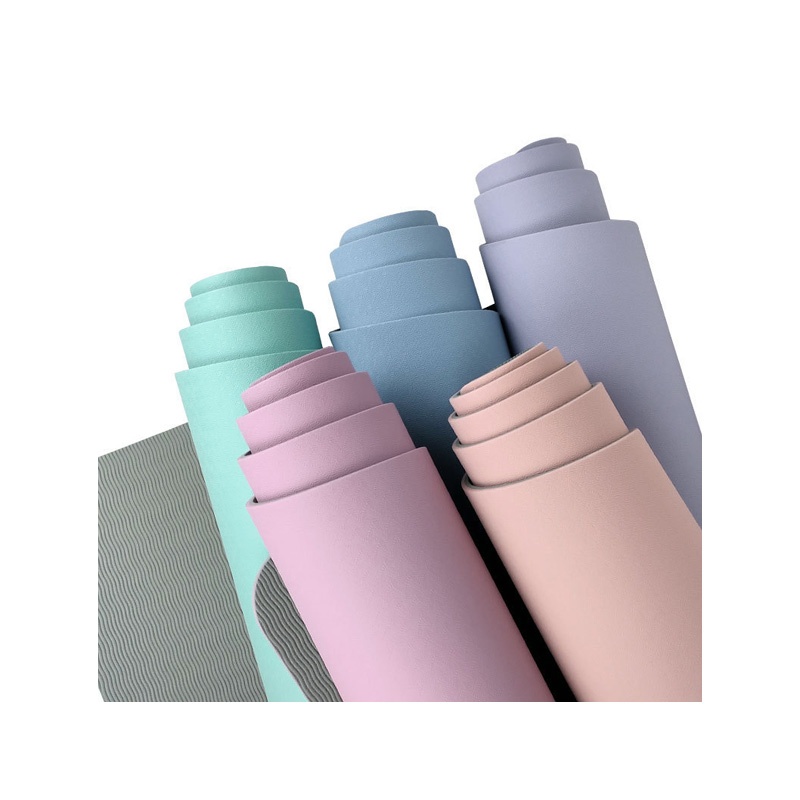 TPE Yoga Mat with Double-Sided Non-Slip TextureLightweight 183 × 61 × 0.6 cm TPE mat with closed-cell structure and non-slip texture, suited to home-fitness bundles with the ball.View Product →
A TPE mat pairs naturally with the ball for home-fitness bundles; specify thickness and texture on the PO, since the same image is often used across two very different gauges.
 EVA Yoga Block for Alignment and SupportHigh-density EVA foam block, 23 × 15 × 7.5 cm and 120 g, with non-slip surface and rounded corners to complete yoga kits.View Product →
EVA blocks complete the set and add little volume. Colour matching across ball, mat and block is the detail that separates a kit that looks designed from three products that happen to share a carton.
Yoga Ball FAQ for Buyers and Retailers
Which yoga ball size sells best in wholesale orders?
65 cm carries most adult home-fitness demand in Europe and North America. Stock 55 cm for studio and prenatal use, and 75 cm for gyms and taller users; a one-size range usually loses the extremes of the height chart.
Is an anti-burst exercise ball the same as a burst-resistant one?
The terms are used interchangeably in retail. Both describe a reinforced wall that splits and deflates slowly after a puncture instead of exploding — and neither protects against over-inflation, which is the leading cause of seam failure.
What is the weight limit of a stability ball?
Ask suppliers for a rated static load rather than a vague maximum. Static ratings on thicker walls are commonly quoted around 150 kg and above, but bouncing and dynamic movement reduce the usable load, so print both figures and label the ball accordingly.
Are PVC yoga balls phthalate-free?
They can be, but the claim needs a report. Specify 6P or 16P phthalate-free status and request a batch-level test report under REACH; a sharp plastic odour on the sample is a practical warning sign of cheap plasticizer.
How are yoga balls shipped — inflated or deflated?
Deflated, almost without exception. Flat packing cuts freight volume sharply, avoids heat deformation inside the container, and lets the end user inflate to the printed circumference. Decide early whether a hand pump goes in the carton.
What is the MOQ for a private-label yoga ball?
It depends on the print method, the number of colours and whether a custom box is involved. Each additional colour or printed SKU splits the production run, so confirm the per-colour minimum before artwork is finalised rather than after.