ENG

 English
 Français
 Español
 عربى

A purchase order that lists nothing but "weight training equipment" is not a specification. The same two words cover a 20 kg cast-iron dumbbell set, a twelve-piece latex band kit, and a plate-loaded leg press — three products with almost nothing in common when it comes to material, tooling, freight, or inspection. Naming the family first is what makes the rest of a spec work.
The short answer: weight training equipment splits into five functional families — free weights, bodyweight and small strength tools, machines and cable systems, elastic resistance tools, and weighted accessories. Each has its own resistance curve, its own dominant materials, and its own failure points. What follows is how they compare, what to check inside each one, and where buyers most often lose money.
The Five Families of Weight Training Equipment
The classification that matters commercially is resistance type, not shape. A dumbbell and a band can train the same muscle, but they load it differently through the range of motion, and that difference drives the material spec, the test method, and the landed cost.
| Family | Typical products | Resistance behaviour | Common materials | Check first |
|---|---|---|---|---|
| Free weights | Dumbbells, barbells, plates, kettlebells | Constant through the range | Cast iron, rubber, PVC, foam, chrome steel | Weight tolerance and coating durability |
| Bodyweight and small tools | Ab wheels, push-up bars, jump ropes, grip strengtheners | Bodyweight plus leverage | PP, ABS, TPR, EVA, steel tube | Handle strength and anti-slip surface |
| Machines and cable systems | Squat racks, functional trainers, lat pulldown, leg press | Variable, driven by cam or pulley | Steel tube, powder coat, PU pads | Tube wall thickness, weld quality, pulley smoothness |
| Elastic resistance | Flat bands, tubes, figure-8 bands, pull ropes | Progressive, rising as it stretches | Latex, TPR, TPE, polyester webbing | Cyclic fatigue and snap-back safety |
| Weighted accessories | Ankle and wrist weights, vests, sandbags, wall balls | Added external load | Nylon, oxford cloth, neoprene, steel shot | Stitching and filling leakage |
Figure 1: how resistance changes through the range of motion for three common equipment families.
Because free weights hold a constant load while a band keeps adding resistance as it stretches, a band rated "20 kg" is not interchangeable with a 20 kg dumbbell. Buyers who treat them as equivalents tend to notice the difference in returns rather than in the sample room.
Everything in the first four families, from ab wheels and grip rings to bands and weighted vests, sits inside our strength training equipment range, so the classification above maps directly onto how the catalogue is organised.
Free Weights: Tolerance Matters More Than Appearance
Dumbbells ship in two commercial formats. Conventional sets use a separate handle and plate assembly; preloaded sets are a single cast or welded unit. Preloaded sets cost more per kilogram but hold their weight better and survive commercial floors, while conventional sets are cheaper to ship and easier to re-plate when a range changes.
The number worth asking for is tolerance. A plus or minus 2% to 3% weight tolerance is typical for commercial-grade cast iron, while budget home sets often run 5% or looser — which matters the first time a customer puts a box labelled 10 kg on a scale. Surface finish is the second checkpoint: rubber-coated heads protect floors, chrome-plated handles resist rust, and foam or PVC-coated dumbbells suit aqua fitness and rehabilitation use where impact has to stay low.
Bodyweight and Small Strength Tools
This is the highest-volume family in most catalogues, and the one where small design details separate a repeat order from a return. An abdominal wheel is a wheel diameter, a wheel width, an axle, two grips, and on brake models a resistance mechanism. Wheel width sets stability for beginners, a dual-wheel layout tracks straighter than a single wide wheel, and foam or TPR grips decide how the product feels after fifty repetitions rather than five.
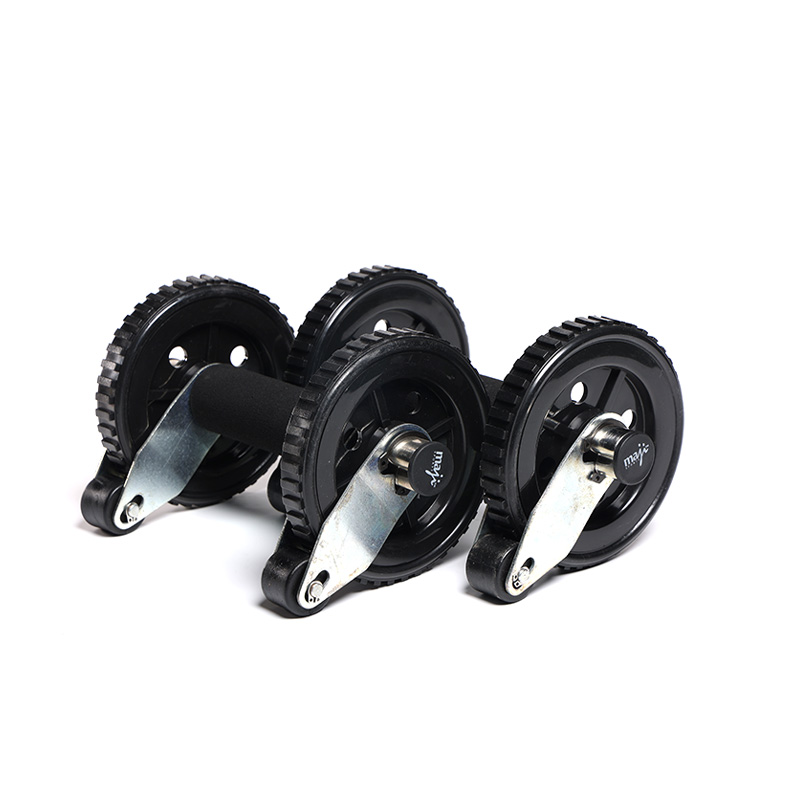 Brake Abdominal Wheel for Core Strength TrainingA 680 g PP, PVC, and TPR abdominal wheel sized 17 by 11 cm, with a brake-style resistance mechanism suited to controlled core training.View Product →
Push-up bars follow the same logic: flat-leg, S-shaped, rotating, and high-low frames each shift the wrist angle and change which muscles do the work. Jump ropes add another variable — cotton and PVC ropes suit general conditioning, while steel-wire ropes running on bearings with counting handles are built for speed work. The newer brake-style abdominal wheel from our own tooling carries a national patent, which is the kind of detail worth asking about whenever a competing quotation looks unusually low.
Figure 2: exploded isometric view of an abdominal wheel and the material choices behind each part.
Elastic Resistance: Bands, Tubes, and Pull Ropes
Elastic tools are sold by resistance level, usually colour-coded, and by material. Latex gives the most consistent stretch and the best elastic memory; TPR and TPE versions cost less and tolerate oils and sunlight better, which suits outdoor and rehabilitation use. Flat bands, tube bands with handles, figure-8 bands, and pull ropes all sit in this family, and the difference between them is mostly the handle and the attachment point.
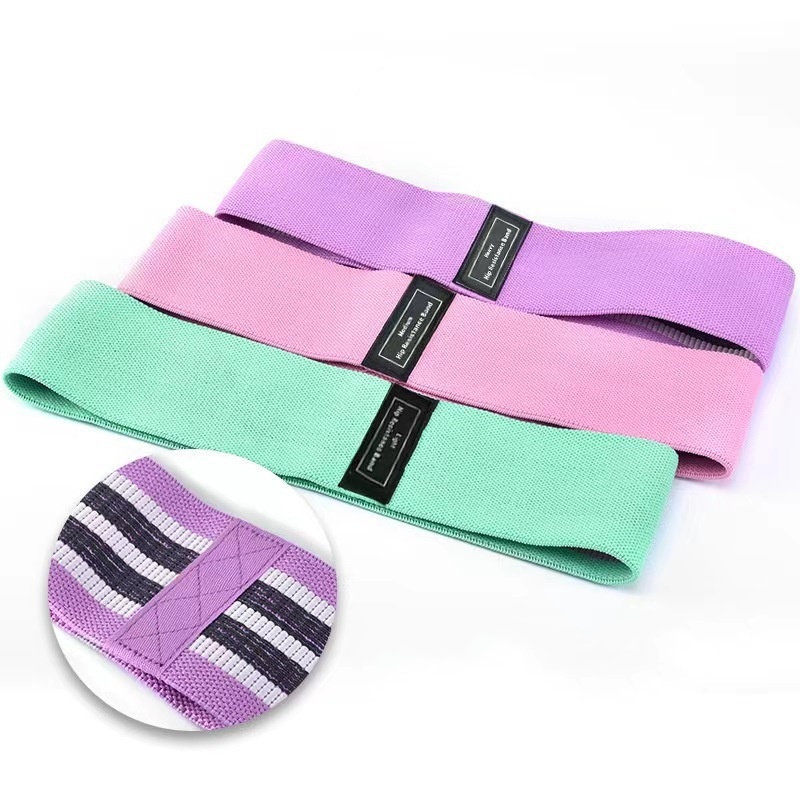 Polyester and Latex Silk Resistance Band SetA 76 by 8 cm resistance band set in polyester and latex silk, weighing 329.3 g for strength-training routines that need a compact elastic tool.View Product →
The failure mode to test for is cyclic fatigue. A band that loses a fifth of its resistance after a few hundred stretches will not hold the level printed on the label, and a band that snaps back at the user is a safety claim waiting to happen. Ask for elongation percentage and cycle-test data rather than a colour chart alone.
Grip, Wrist, and Forearm Tools
Small hand and forearm tools fill the gaps that larger equipment leaves. Adjustable hand grips let one unit cover a range of resistance, counting models add rep tracking for rehabilitation, and silicone rings and finger stretchers work the opposite direction by training extension rather than flexion. Wrist and arm bars, in spring, iron pipe, or stainless steel pipe versions, load the forearm through a twisting or curling motion.
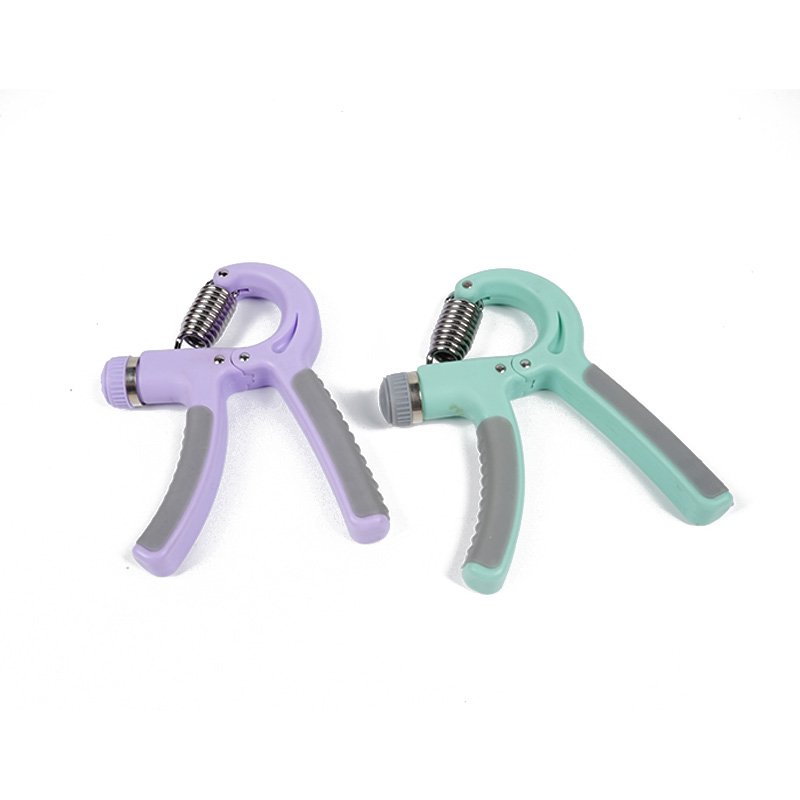 Adjustable Hand Grip with PP and PVC HandleA 100 g adjustable hand grip with a 14.3 cm PP and PVC handle, built for compact hand and forearm strength-training use.View Product →
For these items, spring steel quality and grip material matter most. A TPR or silicone grip that stays soft after thousands of compressions is the difference between a repeat order and a complaint, and it is far cheaper to specify correctly than to replace later.
Machines and Cable Systems: Gym-Grade vs Home-Grade
Machines are where the question of types gets complicated, because the same exercise can arrive through a squat rack, a Smith machine, a functional trainer, or a plate-loaded leg press. What separates commercial from home equipment is not the shape but the steel: commercial frames typically use thicker tube walls and heavier-gauge welds, with larger pulleys and sealed bearings so the cable runs smoothly under daily use.
Cable systems add their own variables — cable construction, pulley diameter, and the ratio of the weight stack. Studio equipment such as a Pilates reformer sits alongside this family for buyers serving yoga and Pilates studios, where frame stability and upholstery density matter as much as raw load capacity.
Weighted Accessories and Support Gear
Weighted accessories add load without adding a machine: ankle and wrist weights, weighted vests, sandbags, wall balls, jump boxes, and barbell pads. The spec question is the filling. Sand shifts and settles, steel shot does not, and stitching quality decides whether the filling stays inside after a few hundred sessions. Oxford cloth and heavy nylon are the standard shells.
Support gear belongs in the same order. Knee pads, patella straps, wrist guards, and shin guards protect the joints that weight training loads hardest. Honeycomb and shock-absorbing constructions are the current retail standard, while sponge versions remain the value option for entry-level programmes.
A Practical Checklist Before You Order
Once the family is clear, the same seven checks apply to almost any weight training equipment order. Run them before the sample stage, not after the container is booked.
Figure 3: a qualitative comparison of three families across five buying dimensions, scored from low to high.
- Resistance family and load range, matched to the end user rather than to a photograph.
- Material grade, specified as PP or ABS, latex or TPR, cast iron or rubber-coated.
- Stated tolerance and rated capacity, given as a number rather than as "high quality".
- Surface and handle finish, covering chrome thickness, knurling depth, and powder-coat adhesion.
- Test data, meaning cyclic fatigue results for elastic goods and load testing for frames and bars.
- Packaging and retail labelling, because the weight printed on the box has to match the product inside.
- MOQ, tooling, and lead time for custom colours, logos, and new moulds.
If you are still narrowing the list, our overview of what buyers consider the most essential fitness equipment covers the categories that move fastest in home and studio settings.
Frequently Asked Questions
Q1. What are the main types of weight training equipment?
Five families: free weights such as dumbbells, barbells and plates; bodyweight and small strength tools; machines and cable systems; elastic resistance tools; and weighted accessories. Most home gym equipment lists mix all five.
Q2. Are resistance bands as effective as dumbbells for building strength?
Both build strength, but the resistance curve differs. Bands get heavier as they stretch, while dumbbells stay constant, so many programmes use bands for accessory and rehabilitation work alongside free weights.
Q3. How much weight should a beginner start with?
A load that can be controlled for 8 to 12 repetitions with clean form. For ab wheels and push-up bars, start with bodyweight and a shorter range of motion before adding any external load.
Q4. What is the difference between home gym equipment and commercial gym equipment?
Mainly steel thickness, load rating, duty cycle, and pad density. Commercial machines typically use thicker tube walls, larger pulleys, and sealed bearings built for continuous daily use.
Q5. How do I choose a weight training equipment supplier?
Confirm whether they manufacture or only trade, ask for factory documentation and test data, agree on tolerance and rated capacity in writing, and approve a sample before mass production begins.
Q6. What is the MOQ for custom weight training equipment?
It depends on tooling. Products with existing moulds, such as ab wheels, grip rings, and jump ropes, usually carry lower minimums, while new moulds or custom colours raise the MOQ.